WRITING
Why They Have to Be Right

You spent three months losing weight. You actually lost ten pounds. You post the photo in the family group chat.
Your mother says: that's just the camera angle.
If you think she said that because she doesn't love you, or because she's cruel, you'll stay angry forever and never get anywhere — you'll try a more objective photo, maybe even film yourself on the scale. It won't work. She isn't discussing whether you lost weight.
She's doing bookkeeping.
This piece is about what that ledger looks like, why it has to be kept that way, and what you can and cannot do once you see it. The immediate payoff: you'll waste a lot less anger, and you'll learn which things you simply cannot change, so you stop throwing effort at them.
1. It isn't lack of capacity — he only has one account
The usual line: their generation didn't see much, they lack the capacity to hear "I was wrong," so they push it outward.
It sounds tidy. It's also flattering — it puts you on the intellectual high ground.
But you know counterexamples.
The boss who built a company worth tens of millions, whose first move after any failure is to blame a subordinate. The parent with a PhD whose only response to a bad exam is "you didn't work hard enough." The sharp, unflappable executive who, the moment a decision is questioned, starts investigating who executed it badly.
These people are not weak. Some are far stronger than you.
So "lack of capacity" isn't the variable. At least not the main one. That explanation is popular because it's easy and it disparages the other person on the way through — but it can't account for the most glaring cases around you.
So what is the real variable? Try a different model.
Picture a person's sense of self-worth as an account. He has to keep depositing into it. As long as there's a balance, he can function.
Some people have exactly one account. Its name might be "I am a competent parent." Or "I have been right about my life." Or "I'm the authority in this field." Or "I'm the capable one in this family."
Some people have a second account. It almost always has the same name: "I'm better today than I was yesterday."
Now someone tells him: on this one, your judgment was wrong.
- If he has a second account: the first one takes a hit, but he can transfer from the second to cover it. And he knows that admitting the mistake and fixing it deposits straight back into that second account. So "I was wrong" isn't frightening — it's a deposit slip.
- If he has only one account: admitting it = the only account goes to zero = the whole person collapses. There's no second pile of money to cover the draw.
So he cannot admit it.
Here's the most important sentence in this piece: passing the blame isn't malice, it's survival.
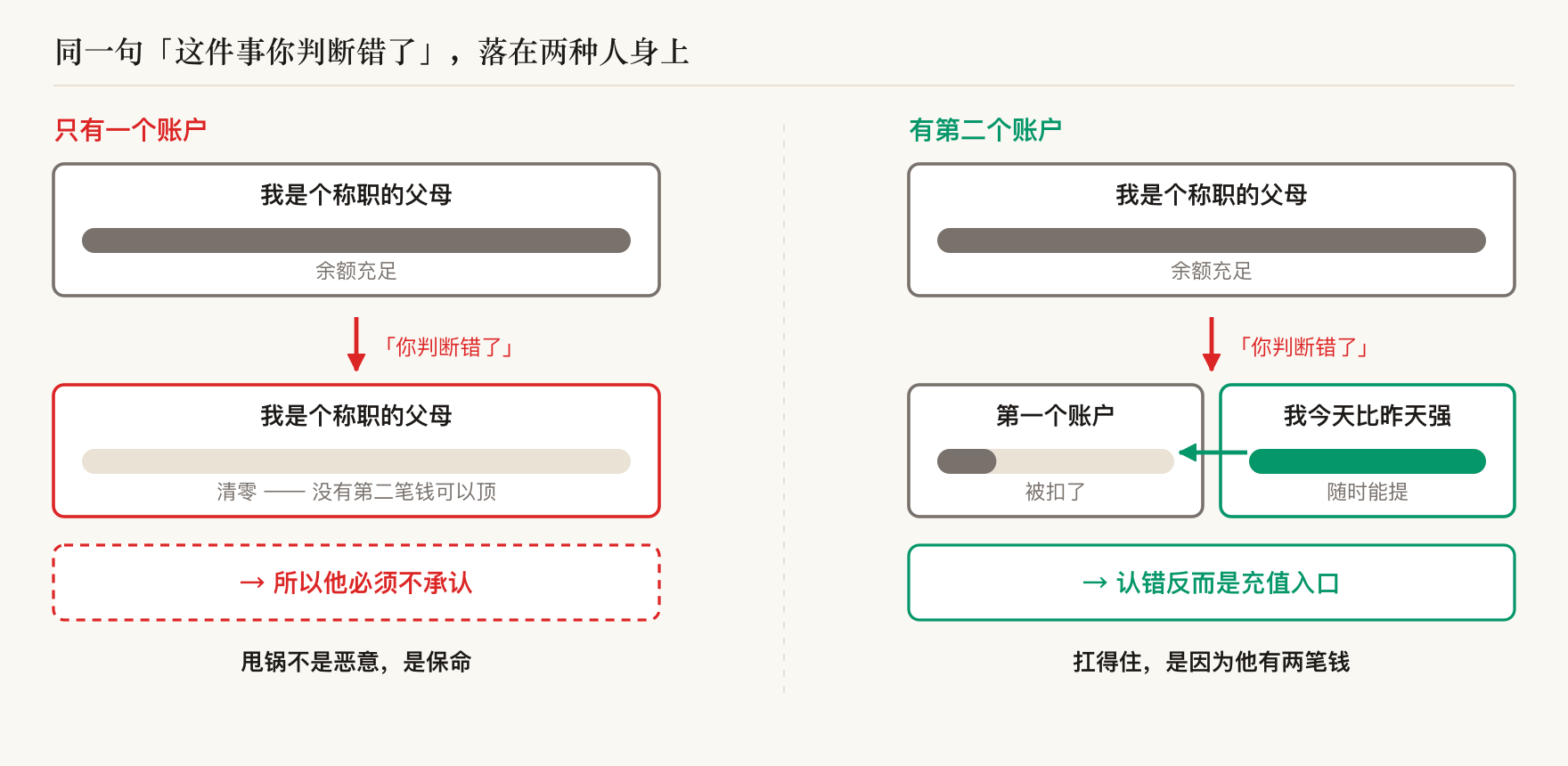
The model also handles those high-capability counterexamples: as long as someone's entire self-worth is staked on one identity he cannot afford to lose, no amount of competence protects him.
If anything it gets worse. Because that identity is worth more, so he can afford the loss even less.
An ordinary person admitting "I handled that badly" loses a little face. A recognized authority admitting the same sentence loses half a lifetime's definition of himself. Which is why the higher the position and the more singular the identity, the harder it is to admit error — that's not a difference in moral character, it's a difference in position concentration.
2. What the ledger looks like: one rule
Once you see the account, the bookkeeping rule follows. There's only one:
Whenever something improves about you, attribute it to the outside — or deny it outright.
| What happened | How it goes in the ledger |
|---|---|
| You got in | You got lucky / it was an easy year |
| You lost weight | Camera angle |
| You got promoted | Your boss looks after you |
| You've had good ideas lately | Somebody's been putting them in your head |
| You pulled off something hard | Change the subject |
Notice what these have in common. What they protect is not "you're inadequate."
What they protect is the ledger entry that says: "the good in you has something to do with me."
Every credit you earned yourself has to be moved into the "external factors" column, or the books don't balance. Because if your gains are yours, it follows that his methods over all those years may have been useless — or harmful. And that is the collateral on his only account.
Which is why those labels — got full of himself, went to his head, fell in with the wrong crowd, swept off his feet — aren't assessments. They're bookkeeping instruments.
Their function is very specific: move a credit out of your column.
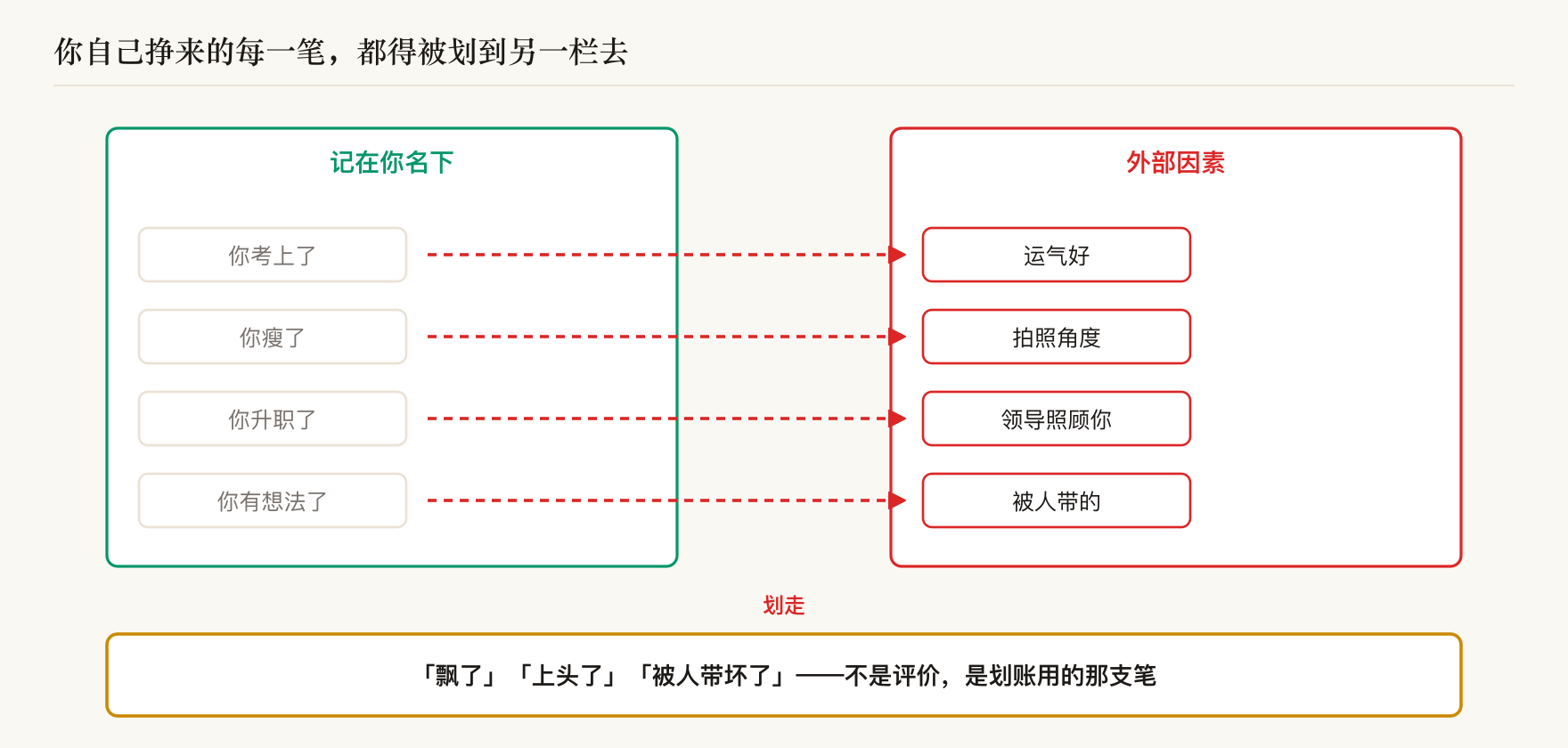
Corollary: arguing "but I really did lose weight" is completely useless. Bring the scale, bring the medical report, bring the before-and-after — none of it works. He isn't discussing your weight, he's protecting his books. The harder your evidence, the more he needs a fresh reason to reassign the entry — you'll notice the reasons change but the conclusion never does. That isn't him being unreasonable. That's the mechanism running normally.
3. The other side: why some people are immune to criticism
Flip it around. You probably also know someone who blows up at the mildest correction, or simply doesn't take it in — deflects, changes the subject, laughs it off.
The popular reading: thin-skinned, can't handle it, spoiled.
Hold on and look at his history.
- A teacher criticized him, but changing nothing would have mattered — the slot was never going to be his
- His family criticized him, but that was mostly a topic for the dinner table
- He actually did change once, and it worked, and the response was: you got lucky
In a history like that, negative feedback is never actionable information. It's a verdict.
Which makes shutting your ears a rational decision, not a weakness.
Nobody keeps investing in something that has never once paid out. He isn't failing to understand. He's run the numbers.
Whether a person can hear criticism has nothing to do with mental toughness. It has to do with whether he's ever seen this loop close:
Heard it → changed → things got better → someone acknowledged it.
Four steps. Break any one and the loop is broken. And the one that breaks most often is the last.
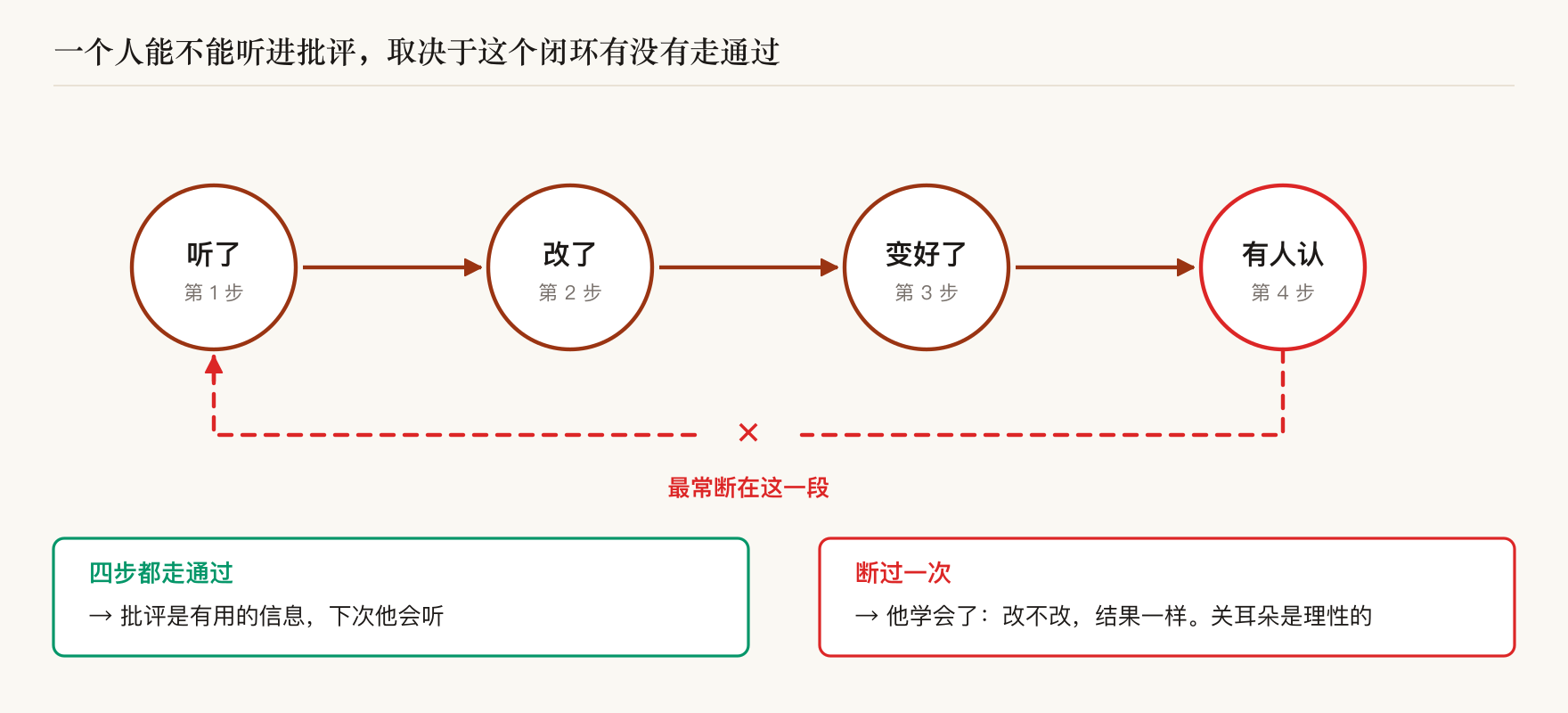
He may well have managed the first three: he listened, he changed, and things genuinely improved. And then nobody acknowledged it. Or worse — someone filed it under "luck" (see the previous section).
Run that sequence once and the lesson is learned: changing makes no difference. Next time he won't listen. That's learning, not a defect.
4. The sending end: you think you're relieving pressure, you're adding it
Now the person giving the feedback. Which is, quite possibly, you.
One kind of person has this default move: whether or not it's my fault, take it on. Because blaming other people produces nothing, and analyzing yourself produces something. The more you take on, the more you can fix, the faster you grow.
The strategy works extremely well. I've run on it for years.
But it works on two conditions:
- You can actually deliver the improvement — you take it on and you really do fix it
- You have a second account — taking it on won't collapse you
The problem is that the person across from you may have neither.
Which produces something quite counterintuitive:
| What you think you're conveying | What he actually receives |
|---|---|
| I'll take the blame first, don't feel pressured | So that's what doing it right looks like — and I can't |
| We're equals | He holds the high ground on both ethics and ability |
| Blame is pointless, analysis isn't | He doesn't even need to be told he's wrong; I can't even manage that |
Someone who always takes the blame first doesn't read as "we're equals" to a person who can't carry it. He reads as standing above them on both counts.
Every time you take it on, another line goes into his ledger of inadequacy. Because he has no capital to match you with — you take it on and grow, he takes it on and collapses.
So the fix isn't giving less feedback, or apologizing less. It's changing the structure:
Criticism has to come with "here's how," and ideally with something finished attached.
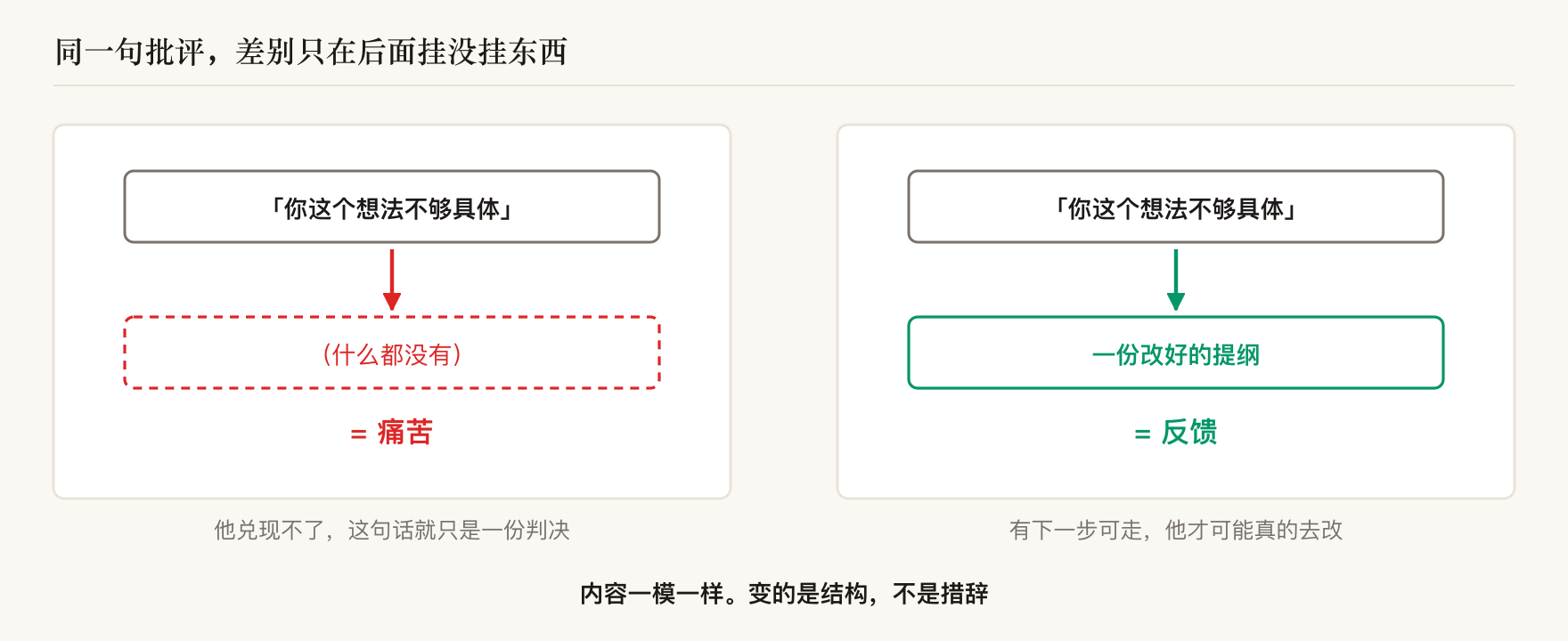
One line for this section: if the other person can't act on what you said, you didn't give feedback. You gave pain.
The difference isn't in the content, it's in whether anything is attached. "This idea isn't concrete enough" followed by a rewritten outline, and the same sentence followed by nothing, are two entirely different acts.
5. Two kinds of looking up — same appearance, opposite direction
One last thing that's easy to confuse.
Two people are looking up to the same person. From outside they look identical: both say "you're amazing," both ask for guidance, both take what he says seriously, both are willing to change for him.
But the directions are opposite.
| Emulating | Attaching | |
|---|---|---|
| Treats the other as | a model | a backstop |
| Motion | take apart → replicate → iterate | ask → get caught → ask again |
| Endpoint | I become that person, then I don't need you | I need you more |
| Catchphrase | "here's what I plan to do" | "can you take a look" |

The test is one sentence: is he saying "here's what I plan to do," or "can you take a look"?
Why does this matter? Because an observer cannot tell them apart.
From outside, the two behave almost identically. So a person climbing as hard as they can gets labeled as starstruck, swept up, led astray. The people applying the label usually aren't being malicious — they genuinely can only see the appearance, not the direction.
And if you happen to be the one being looked up to, the single most useful thing you can do is: hand the credit back, explicitly.
"That's your direction. I just tidied it up."
That one sentence does two jobs at once: it dismantles the observer's "external influence" column, and it nudges attachment one notch toward emulation. It beats any amount of explaining or defending, because it doesn't operate at the level of argument — it changes the attribution directly.
6. Structural judgment, not moral judgment
When you've seen all of this, the biggest change isn't that you've learned how to respond.
It's that you stop being angry.
Because you find that:
- He denies your progress not because he doesn't love you, but because he has only one account
- He can't hear criticism not because he's thin-skinned, but because he's never seen the loop close
- His feedback makes you feel worse not because he's bad, but because he forgot your capital and his are different
All three are structural judgments, not moral ones. The advantage of a structural judgment is that it predicts: knowing the mechanism, you can tell in advance which sentence will trigger which reaction, and which efforts are wasted.
But the boundary has to be stated too.
Patterns like this usually have decades of history. They were running before you showed up and they'll keep running after you leave. They don't stop because you explained the logic well — logic was never their fuel.
What you can do is stop being the fuse. What you cannot do is defuse the bomb.

Tell those two apart and you'll save an enormous amount of energy.
And what you save is just about enough to open yourself a second account.
FOLLOW
New posts land here first. Subscribe via RSS: /feed.xml
AUTHOR
Tianli Zeng
Hydraulic engineer. I write about AI methodology and engineering practice.