WRITING
A Methodology for Water Resources Carrying Capacity Evaluation: AHP-CRITIC-TOPSIS in Practice
Why Combined Weighting
A water resources carrying capacity evaluation typically involves dozens of indicators. Traditional approaches either rely entirely on expert scoring (subjective) or entirely on data characteristics (objective), and each comes with its own bias. AHP-CRITIC combined weighting fuses both perspectives — respecting domain expertise while letting the data have a say.
A Three-Stage Evaluation Pipeline
Stage 1: AHP — Subjective Weighting
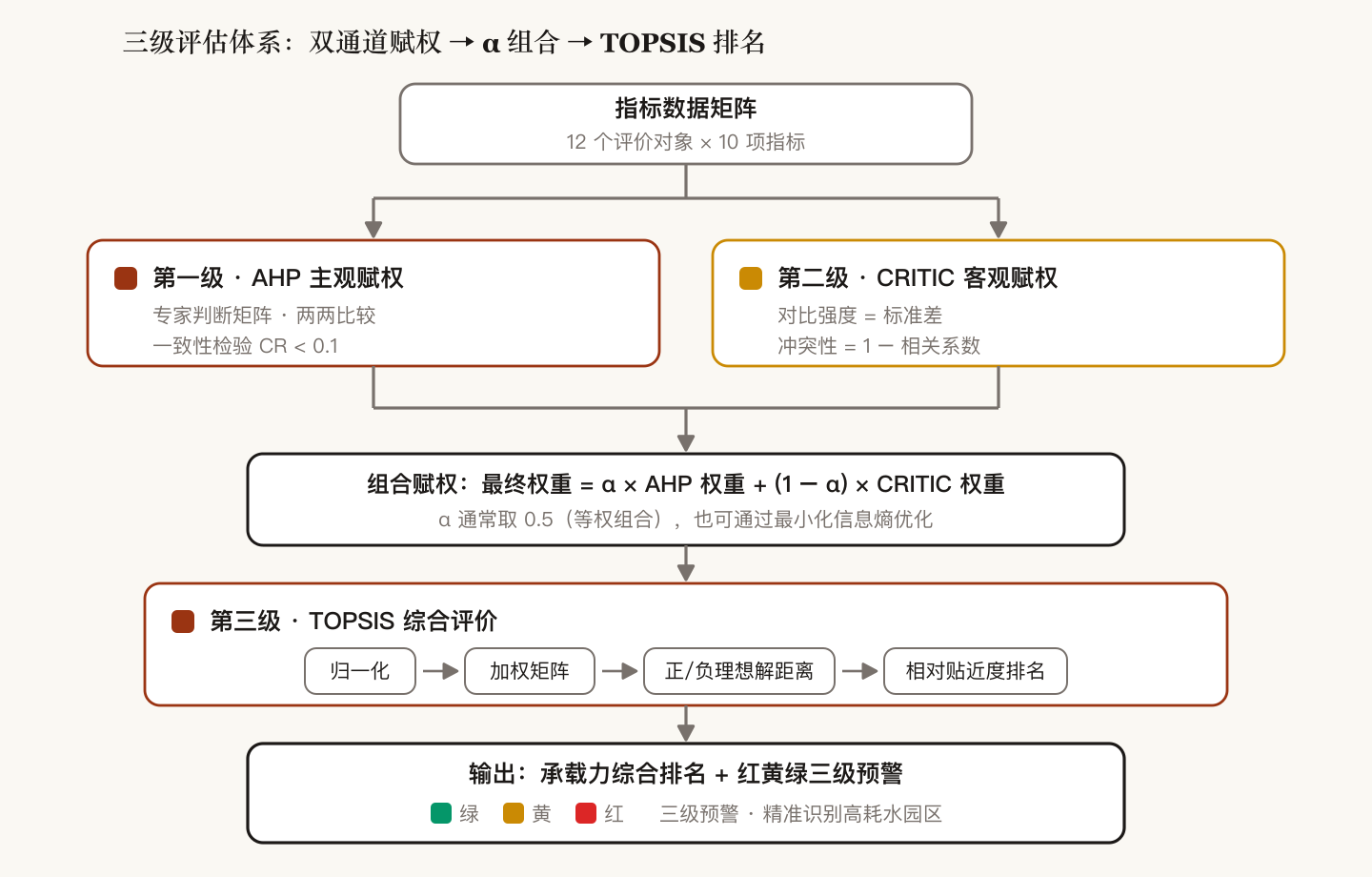
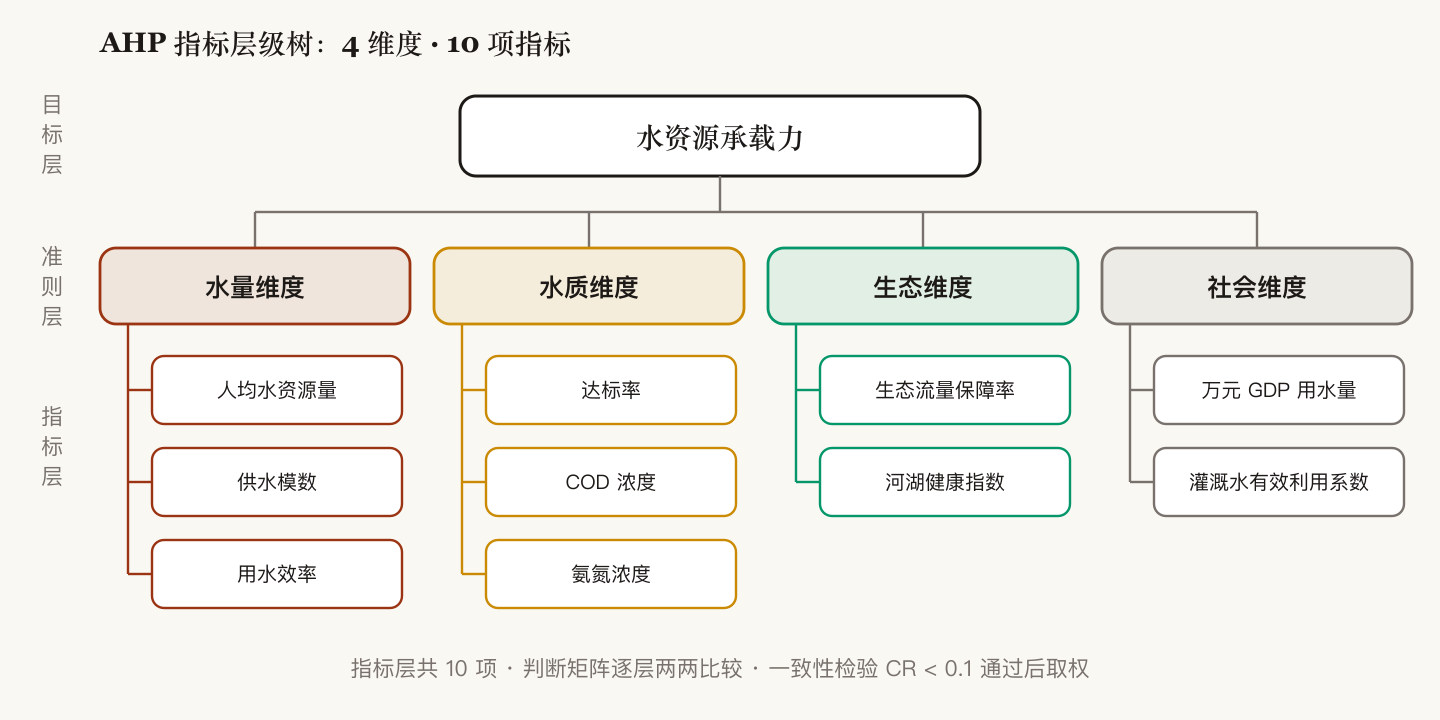
Build pairwise comparison matrices and derive expert weights after passing the consistency check (CR < 0.1). The crux is the design of the indicator hierarchy:
- Quantity dimension: per capita water resources, water supply modulus, water-use efficiency
- Quality dimension: compliance rate, COD concentration, ammonia nitrogen concentration
- Ecology dimension: ecological flow guarantee rate, river/lake health index
- Society dimension: water use per CNY 10,000 of GDP, irrigation water effective use coefficient
Stage 2: CRITIC — Objective Weighting
The CRITIC method derives weights automatically from each indicator's contrast intensity (standard deviation) and conflict (correlation coefficient). Unlike entropy weighting, CRITIC also accounts for information redundancy across indicators.
# CRITIC core computation
contrast = std_matrix  # Standard deviation captures contrast intensity
conflict = 1 - corr_matrix  # Correlation captures conflict
info = contrast * conflict.sum(axis=1)
weights_critic = info / info.sum()
Stage 3: TOPSIS — Comprehensive Evaluation
Normalize the decision matrix → apply weights → compute distances to the positive/negative ideal solutions → rank by relative closeness.
Combined Weighting Strategy
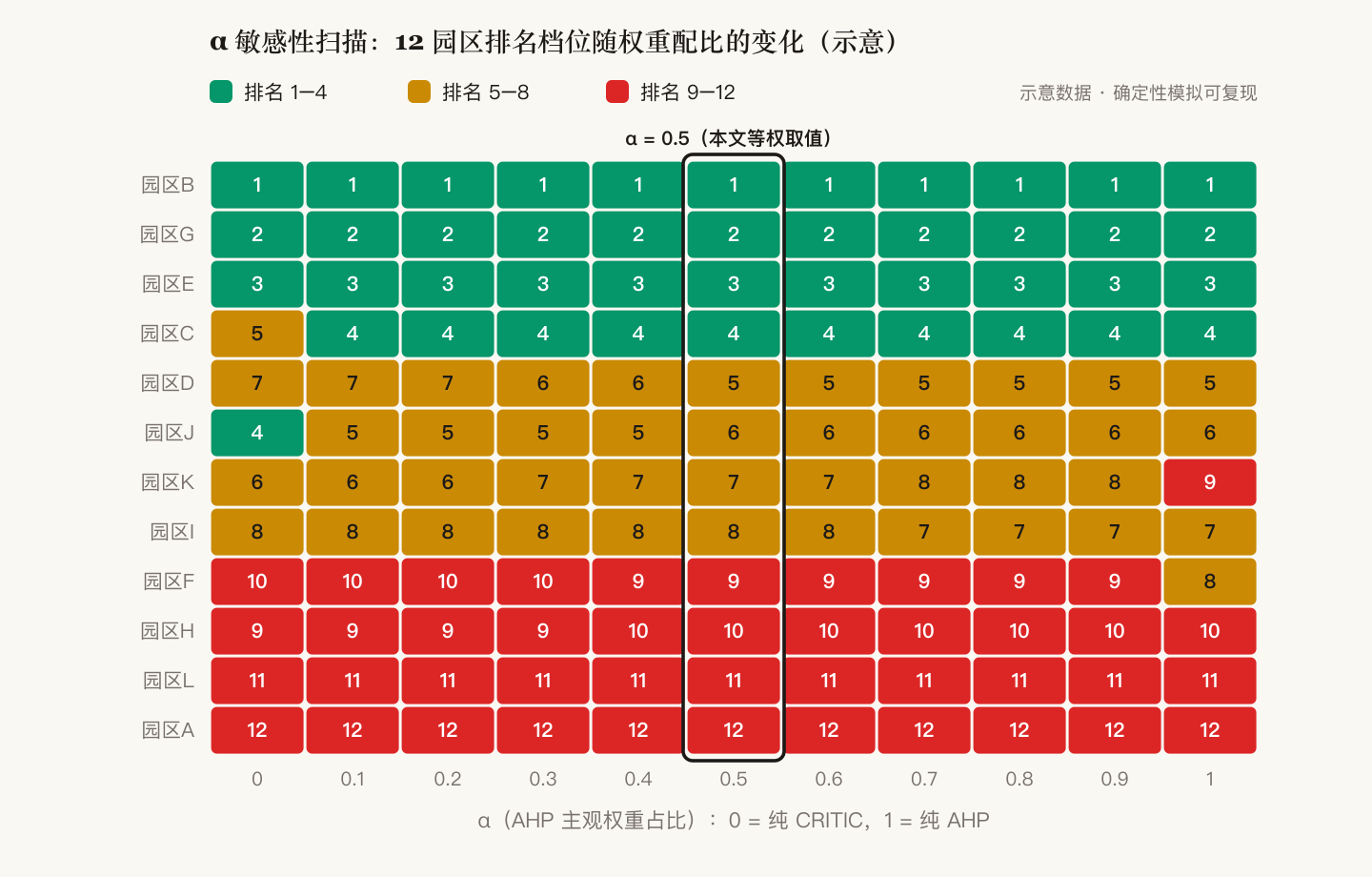
Final weight = α × AHP weight + (1 − α) × CRITIC weight, where α is typically 0.5 (equal-weight combination), though α can also be optimized by minimizing information entropy.
Engineering Considerations
- Indicator standardization: positive indicators use the maximum-value method, negative indicators use the minimum-value method, with care taken around zero values
- Automated consistency check: when CR > 0.1, automatically adjust the comparison matrix
- Sensitivity analysis: vary α to observe ranking stability and produce a sensitivity heatmap
- Report generation: pipe the results into a Word template (python-docx)
Application Case
In a water efficiency assessment project covering an industrial cluster in Zhejiang Province, we used this method to evaluate 12 industrial parks for water-use efficiency, ultimately producing a "red / yellow / green" three-tier alert system that helps regulators precisely identify high-water-consumption parks.
See the project: Industrial Cluster Water Efficiency Assessment System
Wrap-Up
AHP-CRITIC-TOPSIS isn't a silver bullet, but it offers an interpretable, reproducible, and extensible evaluation framework. In the water conservancy industry, this methodology has already been validated in carrying capacity evaluation, water-environment functional zoning, and water-saving assessment, among other use cases.
FOLLOW
New posts land here first. Subscribe via RSS: /feed.xml
AUTHOR
Tianli Zeng
Hydraulic engineer. I write about AI methodology and engineering practice.